Why a Seedling Leans Toward the Light
Why a seedling leans toward the light: read its changing shape, spot uneven illumination, and adjust a windowsill setup without disturbing its roots.
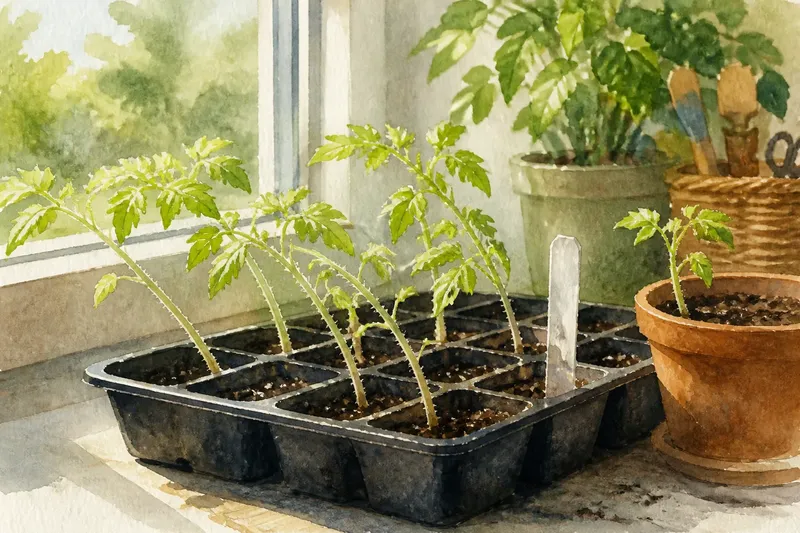
A seedling leaning toward the light is often responding to uneven illumination, not asking for more water. Watch the stem and newest leaves as they grow: their direction can help distinguish a normal response to a window from a setup that needs attention.
Light direction shapes a seedling’s growth
Young shoots respond to light by changing the direction and rate of growth across the stem. When light arrives mainly from a window, the brighter side and the shaded side receive different signals. As the seedling grows, its stem can curve toward the brighter area.
This directional response is called phototropism. It helps new growth orient toward light, where leaves can gather energy. A gentle bend is a normal response, especially beside a window or beneath a lamp placed to one side.
The bend does not tell you how much light the plant receives overall. A bright room can still have a strong directional contrast: the window-facing side may be much brighter than the side facing the room. The seedling responds to that imbalance, not to the room’s general impression of brightness.
Check the pattern before changing the setup
Look at the whole seedling rather than judging one curved stem in isolation. Note where the light comes from, whether the stem is upright near the soil, and whether the leaves look firm or unusually small. Check again after the plant has made some new growth.
- Observation: The stem curves toward a window. If the pot stays in one position, then turn it so the shaded side faces the light; otherwise check whether a nearby object is blocking light.
- Observation: The stem is long, thin, and leaning, with leaves spaced far apart. If this pattern appears, then consider whether overall light is low and improve the light source gradually; otherwise look for a directional source or obstruction.
- Observation: The stem is kinked or pressed against a surface. If it touches a pot, label, or tray edge, then clear the contact; otherwise keep watching the direction of new growth.
- Observation: Several seedlings lean the same way. If they share a tray facing a window, then adjust the tray or light direction; otherwise inspect each seedling for an individual obstacle.
- Observation: The seedling remains bent after the pot is moved. If only older stem sections curve, then assess the newest growth rather than trying to straighten the old stem; otherwise check whether light still comes mainly from one side.
- Observation: Leaves look firm and the stem has a mild curve. If new growth is developing normally, then leave the setup alone or make a small directional adjustment; otherwise check for crowding, contact, or a weak, stretched stem before deciding what to change.
These patterns are clues, not diagnoses. A recently moved pot may still show its earlier direction of growth, because existing stem tissue does not instantly straighten when the light changes.
Correct the light source without chasing every bend
If the seedling is healthy but tilting toward a window, turn the container so the shaded side faces the light. Repeat only as needed to keep growth reasonably balanced. Avoid spinning the pot repeatedly in a single day; the aim is to let new growth respond gradually, not to make the stem change direction at every glance.
For a lamp, arrange it so light reaches the seedling from above rather than from the side. Follow the lamp maker’s directions for placement and timing, since different lights and plants have different needs. An evenly lit growing area is more useful than guessing from the stem alone.
Say you have a tray of tomato seedlings on a kitchen windowsill, and the stems all curve toward the glass. You turn the tray so the far side faces the window, clear a tall plant label that was shading one corner, and watch the newest leaves. If fresh growth becomes more upright while the older stems stay curved, the result suggests that light direction influenced the shape; the old bend need not disappear.
When is a leaning seedling a concern?
A lean deserves closer attention when it comes with a long, weak-looking stem, leaves that appear unusually small, or a stem that is pressed against something. First check for one-sided light, obstructions, crowding, and whether the seedling is otherwise firm. A gentle curve toward a window, by itself, usually calls for observation rather than urgent correction.
What do gardeners ask about a leaning seedling?
Will turning the pot straighten the stem?
Turning the pot can change where new growth points, but it may not erase a curve already formed. Judge the adjustment by the direction of fresh growth rather than expecting the existing stem to become straight.
Should I stake a small seedling?
A mild lean usually does not need a stake, and support can hide the pattern you are trying to understand. If the stem is about to fall over, first check the light and whether the plant is crowded or physically obstructed.
Why is the seedling still leaning after I move it?
Its earlier growth remains shaped by the old light direction, and the new position may still have light coming from one side. Watch the next leaves and stem growth before making another change.
Does a lean always mean the seedling needs more light?
No. A plant can lean in a bright place if the light is uneven. A long, weak-looking stem alongside a directional bend gives more reason to consider low overall light than a gentle curve by itself.
Change one condition at a time
When a seedling looks weak as well as tilted, avoid changing its light, watering, and position all at once. Make one modest adjustment, such as improving the light’s direction, then observe the next growth. This makes it easier to tell which condition mattered and reduces the chance of disturbing a plant through repeated handling.
Also check simple physical causes. A neighboring pot, a tall plant label, or the edge of a tray can block light on one side. Clear the obstruction before moving the seedling to a new location. If the growing medium is dry, water according to the needs of that plant and medium; watering alone will not correct a directional light response.
Do not prune a healthy seedling just to remove a bend, and do not keep turning it in search of a perfectly straight stem. Those efforts are not worth the disturbance when the plant is otherwise growing well.
Use new growth as the clearest evidence
A seedling’s shape records its recent conditions, so the stem you see today may reflect earlier light. Check where the brightest light falls, look for obstacles, and give an adjustment time to show in new growth. For a seedling leaning toward the light, patient observation is often more informative than a quick fix.