The Myth of the One-Plant Border
A one-plant border can look simple but prove hard to read. Learn how measured variation creates clearer rhythm, seasonal interest, and easier planting decisions.
A one-plant border can look orderly on paper and become monotonous in the garden. Repeating one species does not automatically make a border easier to care for or easier to read. A clear composition needs differences in height, shape, texture, and seasonal presence, even when its palette stays restrained.
Repetition has real value: it creates a visual beat and can simplify plant selection. But repetition works best as one part of the design, not as a substitute for it. The useful question is not how many kinds of plants to include. It is what each plant contributes and how those contributions relate.
Repetition creates rhythm, not a complete composition
A border is a long view as well as a collection of individual plants. Repeating a form helps the eye travel along it. A line of upright flowers, for example, can mark a path or draw attention toward a gate. Yet if every plant has the same height, outline, and flowering season, the eye has little else to discover.
Think of repetition as a design verb: it connects, echoes, or emphasizes. It does not necessarily provide contrast, seasonal continuity, or a clear foreground and background. A successful border often repeats one or two elements while varying others. The repeated element supplies coherence; the variations give that coherence something to organize.
This distinction explains why a mixed border need not look busy. A limited set of shapes and colors can remain calm when plants relate to one another. Conversely, a single species can feel unsettled if it grows unevenly, flowers at different times, or leaves gaps that draw attention without intention.
A repeated plant changes with the site and season
Even a uniform planting changes over time. New growth, flowering, seed heads, and dormant stems alter its outline. Differences in light, soil moisture, and competition can also affect how individual plants develop. A repeated plant may therefore produce a patchwork rather than the even surface a plan seemed to promise.
Some species spread by runners or self-seed, while others form distinct clumps. Some need regular deadheading to look tidy; others look better when their spent stems remain. A single choice can bring several kinds of maintenance, particularly if its best appearance depends on a brief flowering period or frequent editing.
Site conditions matter, too. A border can shift from sun to shade, or from dry soil near a wall to moister ground by a downspout. One plant may cope well in one portion and struggle in another. Selecting plants for those differing conditions can be simpler than expecting one choice to perform everywhere.
These are not reasons to avoid repetition. They are reasons to check a plant’s growth habit and the actual bed before treating a repeated planting as a low-effort solution. Consider mature form, spreading behavior, seasonal appearance, and the conditions each stretch of border offers.
Variation gives the border a clearer structure
Variation is useful when it gives the eye clear signals. A low, spreading plant at the edge establishes a foreground. A taller, upright form behind it creates a second plane. A rounded clump can interrupt a run of narrow leaves, while a fine-textured plant can soften the edge of a broad-leaved one.
These contrasts help viewers distinguish parts of the planting without requiring a different flower color at every turn. Leaf shape and plant outline remain visible when flowers are absent, so they can carry the design through the season. Flower color matters, but it is only one way plants can relate.
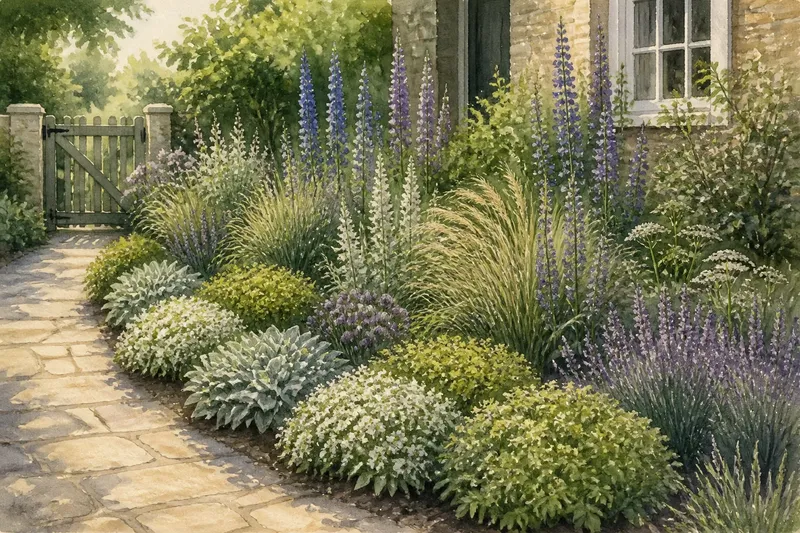
For a restrained border, select a small group of compatible forms and repeat them at deliberate intervals. A grass-like plant might recur as a fine-textured accent, while low mounds connect those accents. A taller flowering plant can appear in several clusters rather than in an uninterrupted stripe. Repeated groups connect the border; the shifts between them prevent a flat effect.
Scale matters. A narrow bed beside a path may not have room for several layers of tall plants. A deep border can support a clearer progression from low edge to taller interior. Judge the planting from the places where people will see it: the path, a doorway, or a window.
Use a limited palette to keep variation unified
Unity comes from relationships, not sameness. Plants can share a color family, similar growing conditions, or a compatible sense of scale while differing in form. The shared qualities help the eye connect the planting; the differences give it texture and movement.
Start by deciding what the border should do. It might frame a view, soften a fence, guide someone along a path, or mark a transition between lawn and patio. Then decide which part should attract attention and which parts should support it. A border framing a doorway, for instance, may call for a steady, low edge and a few taller accents rather than equal visual weight everywhere.
Say you have a sunny strip beside a path and want a calm planting that does not look like a hedge. Imagine choosing low mounds for the front, upright flowering clumps for spaced groups behind them, and a fine-leaved grass-like plant to bridge the gaps. First, check the plant descriptions for sun needs and mature spread; if any choice exceeds the available space, substitute a more compact form. Next, sketch the mounds as a repeating edge and place the upright clumps behind them; if the sketch reads as one solid stripe, widen the gaps or regroup the clumps. Finally, add the fine-textured accents only where the transition looks abrupt; the expected result is a border with a steady rhythm and visible changes in height and texture. The tradeoff is that a mixed planting may need more considered placement than a single row.
Keep the palette limited if a varied planting starts to feel scattered. Repeating a leaf texture, limiting flower colors, or grouping plants with similar visual weight can restore coherence. Adding a new species merely to fill a temporary gap is usually not worth the effort; first consider whether an existing plant can be repeated nearby or whether the gap is part of the intended rhythm.
How can you decide whether one plant is enough?
When does a single-plant border work well?
It works best when the plant has a pleasing form across more than one season and suits the conditions throughout the bed. A mass can also make sense when the design calls for an uninterrupted sweep, such as a low edging or a focused display.
Why can a repeated planting look uneven?
Plants respond to local differences in light, soil, water, and competition, so matching specimens may not grow at matching rates. Flowering and dormant stages can also expose gaps or change the border’s outline.
How many plant types should a border have?
There is no useful fixed number. Choose enough forms to provide the height, texture, and seasonal presence the site needs, then repeat selected plants so the result still reads as one composition.
Can a mixed border still be low maintenance?
Yes, if the plants suit the site and their growth habits fit the space. A varied palette is not automatically demanding; the work depends more on plant choice, spacing, and the appearance you accept between pruning or seasonal tidying.
Let the site set the limits
Before planting, note where the border is sunny or shaded, where the soil dries quickly, and where a wall or path constrains mature growth. Check plant labels and reliable nursery descriptions for mature size, spread, and preferred conditions. The right choice depends on those details and on any relevant local planting rules.
Then sketch the border as broad areas rather than placing every plant as an isolated dot. Mark the low edge, taller groups, and repeated accents. This makes it easier to see whether a feature may form a clear run, disappear behind another plant, or compete with the focal point.
Allow plants room to reach their natural forms. Closely packing one species to create an instant solid band can lead to crowding as it matures. A considered mix may take time to fill in, but it can provide structure before every plant reaches full size. Judge the mature composition, not only the first season’s gaps.
Finally, view the border from a distance and up close. From the path, look for a legible outline and a rhythm that leads the eye. Nearby, check whether leaves and flowers have enough contrast to remain distinct. The planting works when both views support each other.
The myth of the one-plant border is not that repetition fails. It is that repetition alone solves the design. Use a repeated plant where it creates a useful beat, and introduce variation where the border needs a change of height, texture, or seasonal presence. That balance lets a planting develop without asking every section to look identical.