The Walled Garden: Shelter, Status and Growing Space
The walled garden’s history explains how enclosure protected crops, displayed status, and shaped views; learn to read those clues in gardens today.
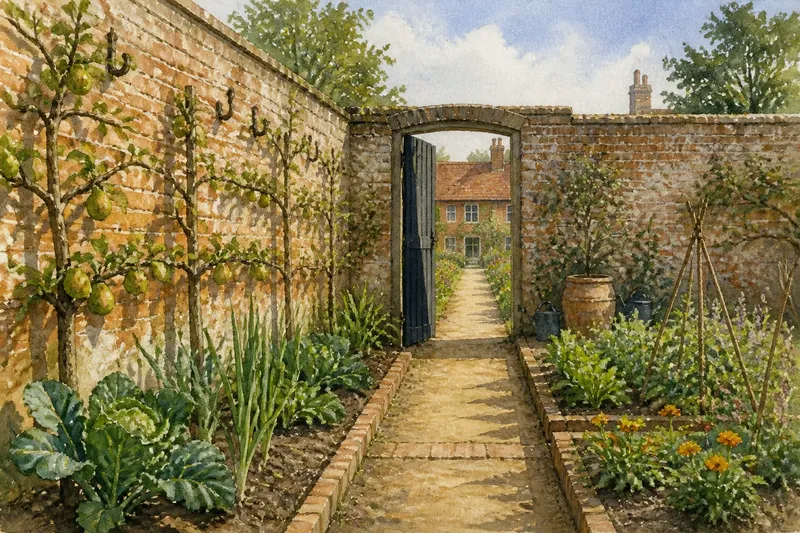
A walled garden can feel sheltered before you notice what is growing there. The wall interrupts wind, holds warmth, and turns an open plot into a sequence of rooms. Its history makes that enclosure legible: it could protect valuable crops, display a household’s resources, and control who saw or entered the space.
To read a walled garden, start with the boundary, then look at its openings, the ground it encloses, and the views it permits. These clues help distinguish practical evidence from assumptions about status. They also explain why an old garden may feel private or formal even after its original use has vanished.
The wall sheltered plants and defined a boundary
Before treating a wall as a symbol, ask what it could do. A solid boundary can reduce exposure to wind, shield plants from animals, and provide a surface against which fruit trees may be trained. In a cool or unsettled climate, that shelter can make a protected growing area more useful than an equally sized open plot.
Material offers clues, though not a complete answer. Brick, stone, earth, and timber reflect local resources and building habits. A thick masonry wall may retain warmth into the evening, while a lower or more permeable boundary may mark a limit without creating the same enclosed conditions. Repair patches and changes in material can indicate that a wall was maintained or adapted over time.
Notice its height and continuity, too. A tall, unbroken boundary can block wind and sightlines, while a low wall can define a garden edge without hiding the land beyond. Neither form has a single meaning. A wall might have been built for protection, privacy, cultivation, or several purposes at once.
Gates show how people entered and moved
Find the entrances. A wide gate may have allowed carts, tools, or produce to pass. A narrow doorway suggests more limited movement. An opening aligned with a house, path, or service area can reveal how people reached the garden and which parts of a household it served.
Openings also shape what visitors can see. A doorway that frames a central path makes entry feel deliberate. A gate set aside from the main approach may keep a productive area out of the most prominent view. These arrangements can distinguish a garden meant for work from one designed to be encountered as a composed scene, though the same place may have done both.
Do not assume that a locked or narrow entrance proves exclusivity. Gates change, and later owners may have altered access for convenience. Treat the opening as a clue to movement, not a firm record of who was allowed through.
Planting and paths reveal how the ground was used
After tracing the boundary, study the ground it contains. Repeated straight beds, remnants of trained fruit trees, planting supports, or a nearby water source can point to intensive cultivation. A sheltered enclosure was useful for crops that needed protection and close attention, as well as for storing tools and organizing seasonal work.
Walls could also serve as growing surfaces. Gardeners trained branches against masonry, making efficient use of limited ground and taking advantage of the wall’s warmth. Old fixing points, tree scars, or a regular rhythm of supports may mark former planting rather than decoration alone.
Not every walled enclosure was a kitchen garden. A formal court, orchard, or mixed garden might include productive plants alongside ornamental paths and seating. Consider how the clues relate: paths leading toward work areas, planted edges that follow the sun, or a service entrance near the house can suggest how cultivation fitted into daily life.
Enclosure could express ownership and status
A wall took labor and materials to build and maintain. In settings where wealthy households or institutions controlled land and resources, enclosing a garden could signal ownership and command over space. The boundary distinguished inside from outside, and those who tended or entered the garden from those who viewed it beyond the wall.
Status did not come from the wall alone. Its effect depended on what lay inside, how the garden related to the house, and whether visitors were invited to see it. A carefully arranged entrance, a view toward a residence, or an orderly planting scheme could turn useful ground into a display of care and authority. Productive and social purposes could overlap: a garden might provide crops while showing that its owners could protect and manage the land.
Read status as a possibility, not a verdict. A plain wall may have been built chiefly to shelter plants, while a grand entrance may have served ordinary access. Several clues that agree make a stronger interpretation than one impressive feature on its own.
Views turn an enclosure into a sequence of spaces
Stand beyond the boundary and ask what the wall hides and what it reveals. A closed face may keep work out of view. A gateway may offer a deliberate glimpse of a path or planting. From inside, the same opening can direct attention toward a house, a distant landscape, or a particular part of the garden.
This change in viewpoint helps explain how walls organize experience. They can make a small plot feel separate from its surroundings, but they can also frame a view and connect the garden to a larger estate. A visitor may encounter the space as a sequence: approach, threshold, path, then a more private or productive interior.
Say you are examining an old brick enclosure with a narrow gate, a row of old fixing points along its sun-facing side, and a straight path leading toward the house. The fixing points could mark trained fruit, while the path suggests a direct route between residence and growing space. You would then look for planting remnants or a service entrance; if those clues appear, a productive garden becomes more plausible, while their absence leaves room for a mixed or ornamental use.
What can the walled garden’s history tell you?
Why were gardens enclosed?
Walls could shelter plants from wind, animals, and casual disturbance, while defining ownership and regulating access. Their purpose often combined several practical and social needs.
How did walls help gardeners grow fruit?
Gardeners could train branches against a wall and use its protected surface to support cultivation. The planting depended on local climate, materials, and available space.
Does a high wall always signal wealth?
No. It may indicate a need for shelter, privacy, or security, as well as the resources to build it. Consider the entrance, nearby buildings, and evidence of cultivation before drawing a conclusion.
Why can an enclosed garden feel like a separate room?
A continuous boundary limits views and marks a threshold, while paths and openings guide movement within it. That arrangement gives the garden a distinct interior even though it remains outdoors.
Modern boundaries still shape garden use
Modern boundaries affect how a garden works and feels. A wall can shelter a seating area, screen a compost space, support a climber, or make a small courtyard feel distinct from the street. Its appearance also tells visitors whether the space is open, private, formal, or intended for everyday use.
When considering an existing wall, note where sun falls, where wind enters, how people move through the garden, and which views the boundary blocks or frames. These observations help you understand the enclosure before changing it. If you are adding a boundary, choose its height and openings in relation to the job you want it to do, rather than copying the look of a historic garden without its context.
It is not worth assigning a precise social meaning to every stone or gate. Walls are altered, reused, and repaired; several purposes can overlap. A careful reading stays close to visible evidence.
The walled garden’s history is easiest to read where function and feeling meet at the boundary. A wall may protect crops while shaping who sees them and how a visitor enters. Follow material, access, cultivation, and views, and the enclosure becomes a record of how people organized growing space and social space.