A Winter Walk Through the Garden, Looking for Shape
A winter garden walk helps you read stems, seed heads, and evergreen shapes, then choose what to keep, trim, or reconsider in the planting.
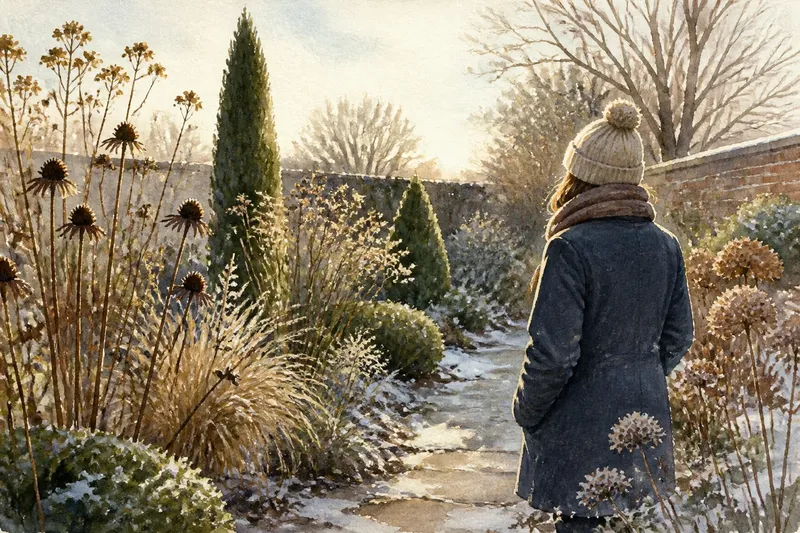
A winter garden walk can show where stems, seed heads, and evergreen forms give a bed its shape. Follow one path slowly and notice which outlines catch the light, which disappear against a hedge, and where a plant blocks a view. These observations help you decide what to leave in place and what to revisit before growth returns.
Choose your approach by what the garden needs
A new border needs observation before intervention. A crowded bed calls for attention to overlap, while a wildlife-friendly planting may benefit from leaving useful cover undisturbed. Start with the condition you see, then let it guide your walk.
- If the planting is new or unfamiliar, check which stems and seed heads are still recognizable. If you can identify their forms, leave them for now; if you cannot, note their location and check the plant’s label before cutting.
- If the border feels crowded, check for stems merging into one mass or hiding smaller plants. If the overlap obscures a shape you want to see, mark the spot for review; otherwise, leave the planting intact.
- If you want winter interest with little upkeep, check for sturdy stems, clear seed-head outlines, or a distinct evergreen silhouette. If one reads clearly from a regular viewpoint, keep it in the composition; if none does, avoid adding decorative objects just to fill the space.
- If wildlife matters to your choices, check whether seed or sheltered cover remains and whether it obstructs a route. If it is useful and out of the way, leave it; if it blocks access, move or remove only the obstructing material.
- If the garden looks tidy but lifeless, check whether every plant has the same low outline. If a sound stem or seed head could add contrast, leave selected forms in place; if the uniformity is part of the intended design, do not change it just to create variety.
- If an evergreen seems out of place, check its silhouette from the path and a window. If it blocks a wanted sightline, note that view for later review; if it anchors the bed from both angles, leave its position alone.
These checks guide observation, not plant-specific care. A plant’s behavior, exposure, and intended use all matter. When a plant label or local guidance gives specific care instructions, consult that information before changing your routine.
Read stems as lines in the winter view
Stems make the garden’s basic drawing. Some stand upright like fine vertical marks. Others arch, zigzag, or form a low web. Look at them against a clear background such as a fence, wall, or pale sky; a busy hedge can hide their outlines.
Ask whether a stem’s shape is visible from places where you spend time. A tall branching stem may read clearly beside a path but disappear from a kitchen window. A low clump can have more presence near a seat, where its texture sits close to eye level.
Notice how stems relate to one another. Repeated upright forms can create rhythm, while a curved stem can soften a rigid edge. If several plants make the same dense shape, note where their outlines merge. Do not cut a stem just because it looks untidy by itself; its pattern may make sense across the whole bed.
Decide which seed heads contribute to the view
Seed heads add distinct shapes: buttons, cones, branching sprays, or loose fans. Their value depends on their position and condition. An upright head can create a focal point; one that has fallen across a path may need to be moved or removed.
Look for contrast in scale and texture. A rounded head can stand out among narrow blades, while fine branching stems can soften a dense evergreen mass. A few visible heads may read more clearly than every spent flower left in place. The aim is to keep forms that contribute to the view, not to preserve every dry stem.
Say you have a sunny border with dried coneflower heads leaning over a walkway and other heads standing upright farther back. First, note which stems cross the walking line. Then remove or reposition only the material that obstructs it, following the plant’s care guidance. The expected result is a clearer route, with the upright heads still visible against the bed.
Use evergreen forms to anchor the scene
Evergreens provide shape when deciduous plants have lost their leaves. Consider more than color. A compact mound, narrow column, spreading groundcover, and clipped hedge occupy space in different ways. Look at each outline beside nearby stems and ask whether it holds the view together or dominates it.
Notice where evergreen shapes repeat. A small shrub echoed by a low evergreen clump can connect two parts of a border. Repetition works when the forms relate without matching in every detail. If an evergreen sits alone, look for a nearby plant with contrasting height or texture before deciding that anything needs to change.
Check the view from more than one angle. A plant that anchors a path approach may block a window from indoors. An evergreen seen through a bare branch can make a plain view feel composed. Keep routes and sightlines in mind rather than judging a plant only from directly in front of it.
Use these winter garden walk questions to guide a decision?
Should all perennial stems be cut down for winter?
No. Some stems add visible structure or shelter, while others collapse or obstruct a route. Keep well-positioned forms that serve the view, and check plant-specific care guidance before cutting.
How can you tell whether a seed head still adds interest?
Look at its outline from the path and a frequently used window. If it remains distinct and stays clear of routes, it may be worth keeping; if it blends into a tangle or leans where people walk, consider editing it.
What should you notice about evergreen plants?
Focus on silhouette, scale, and placement rather than treating every evergreen as a patch of green. Ask whether its shape balances taller stems, marks an edge, or blocks a view you want to keep.
Make a useful note, not a full redesign
Record only decisions that need another look. A note such as “compare this clump with the fence behind it” is more useful than a general verdict like “winter border needs work.” If a form is hard to interpret, sketch its height and direction or take a photograph from a familiar viewpoint.
Separate observations from proposed changes. “The seed heads lean into the path” describes what you see; “move the plant” is one possible response. The observation is clear, while the response may need to wait until you can see how the plant grows and what space it needs.
It is not worth the effort to preserve a weak outline just because a bed looks bare, or to add decorative objects to compensate for a quiet season. A resting garden can be simple and still feel coherent.
Let one visible detail shape your next decision
Before leaving, choose one detail to revisit: a stem worth keeping, a seed head that needs to move out of a route, or an evergreen that may block a useful view. A winter garden walk is most useful when it turns a vague impression into a modest decision based on what you can see. Keep the note tied to a familiar viewpoint, and you will have a clear point of comparison when growth returns.